Few crops have changed the world quite like sugar cane. The history of sugar stretches back at least 10,000 years, touching nearly every continent and reshaping economies, migration patterns and ecosystems along the way. Understanding where sugar cane originated, how it spread across the globe, and how sugar cane is processed today puts the modern industry in a perspective that a simple price tag never could.
What is sugar cane?
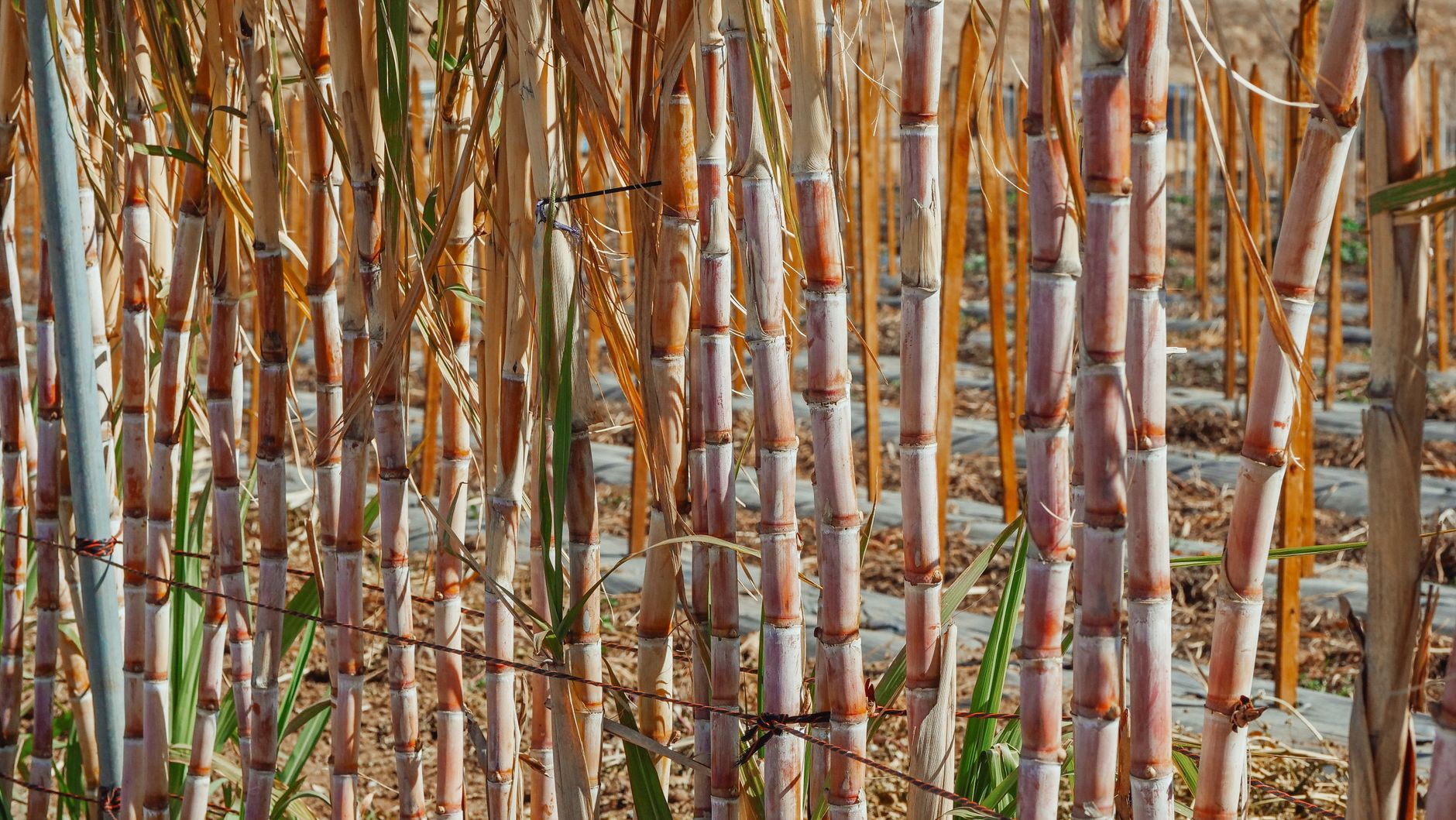
Sugar cane is a tall perennial grass belonging to the genus Saccharum. It grows in tropical and subtropical climates, typically reaching 3 to 6 metres in height, and stores sucrose in its thick fibrous stalks. That sucrose is the raw material for the refined white sugar most people use daily, as well as for raw sugar, molasses, ethanol, and a long list of industrial products. The plant is not a single species but a group of hybrids, with Saccharum officinarum being the dominant commercial variety grown on sugar plantations worldwide.
Where did sugar cane originate?
The origin of sugar cane points squarely to New Guinea, where local peoples began domesticating wild Saccharum robustum grasses around 8000 BCE. Early cultivation involved chewing the raw stalks for their sweet juice. From New Guinea, the plant moved west into the Indian subcontinent roughly 6,000 years ago, carried by Austronesian-speaking peoples trading along island chains. India is where the story of processed sugar truly begins.
Indian farmers in the Indus Valley were the first to extract juice from cane on a meaningful scale. By around 500 BCE, people in the Gupta Empire had developed a method of crystallising cane juice into a granular solid. This was arguably the invention of sugar as a storable commodity rather than a field snack. The Sanskrit word sharkara, meaning grit or gravel, became the root of the Arabic sukkar, the Italian zucchero, and eventually the English word "sugar".
How sugar spread across the ancient world
Persian armies encountered crystallised sugar in India around 510 BCE when Darius the Great's forces reached the Indus. The Persians kept the knowledge largely to themselves for centuries, refining the crystallisation process further. Arab traders carried sugar west after the Islamic conquests of Persia in the 7th century CE, establishing sugar plantations across the Mediterranean. Sicily, Cyprus and the coast of North Africa all grew cane under Arab agricultural management.
Crusaders returning from the Levant in the 11th and 12th centuries brought sugar back to northern Europe, where it sold at extraordinary prices as a spice and medicine. Venetian merchants dominated the trade. Sugar was so valuable that it was stored in locked chests alongside pepper, saffron and gold.
Sugar plantations and the Atlantic trade
Portugal changed the scale of everything. In 1425, Portuguese settlers introduced sugar cane to Madeira and quickly built the first Atlantic plantation economy. By the late 1400s, the model had moved to São Tomé off the West African coast, and then to Brazil after 1500. Brazil became the world's largest sugar producer within a century, a position it held for over 200 years.
The plantation system that emerged was brutal. Sugar cane is labour-intensive at harvest, and European colonisers turned to the transatlantic slave trade to supply that labour. Historians estimate that roughly 40 percent of all enslaved Africans transported to the Americas were sent specifically to sugar-producing regions, principally Brazil and the Caribbean. The sugar plantations of Barbados, Jamaica, Saint-Domingue (now Haiti) and Cuba became among the most profitable and most violent agricultural operations in recorded history.
Britain's Caribbean colonies supplied so much sugar by the 1700s that the commodity shifted from a luxury to a daily staple. Average sugar consumption in England rose from under 2 kilograms per person per year in 1700 to around 8 kilograms by 1800. The sweet cup of tea became a symbol of British culture, underpinned entirely by enslaved labour in the tropics.
Who discovered sugar? A question of credit
The question of who discovered sugar doesn't have a single answer. New Guinean farmers domesticated the plant. Indian technologists invented crystallisation. Persian engineers improved refining. Arab scholars and traders spread the knowledge. Each group added an essential step. The popular framing of a single discoverer belongs to European mythology, not to the actual record.
What can be said is that the first written account of solid sugar appears in Indian medical texts from around the 4th century CE, making Indian scholars the earliest documented describers of sugar as a distinct substance rather than a juice.
Where is sugar grown today?
Sugar cane grows commercially across a belt between roughly 35 degrees north and 35 degrees south of the equator. Brazil produces more cane than any other country, accounting for around 40 percent of the world's sugar exports. India is the second-largest producer, followed by China, Thailand and Pakistan. Australia sits comfortably in the top 10 exporters, with Queensland producing the vast majority of the national crop along a coastal strip stretching from Mossman in the north to Grafton in the south.
Beet sugar now accounts for roughly 20 percent of global sugar production, grown primarily in Europe, Russia and the United States. The crop expanded sharply in the 19th century after the Napoleonic Wars cut off British Caribbean supply lines and France invested heavily in domestic beet refining.
How is sugar cane processed?
Modern sugar cane processing follows a sequence that would be recognisable in outline to a 16th-century miller, even if the machinery is unrecognisable. Harvested cane is crushed through heavy rollers to extract the juice. The juice is clarified with lime, heated, and then evaporated under vacuum to concentrate the sucrose. Crystallisation follows, producing raw sugar crystals coated in molasses. Those crystals are then sent to a refinery where they're washed, dissolved, filtered and re-crystallised into the white sugar that fills supermarket shelves.
The fibrous residue left after crushing, called bagasse, isn't wasted. Modern mills burn bagasse to generate steam and electricity, making many sugar mills largely energy self-sufficient. Molasses, the thick syrup stripped from raw sugar, goes into rum production, stock feed, and fermentation for ethanol. In Brazil, a large share of cane goes directly into bioethanol rather than food sugar, powering a significant portion of the country's vehicle fleet.
For a closer look at the processing side, the Sugar Research Australia organisation publishes detailed technical resources on how Australian mills operate and where research into more efficient extraction is heading.
Sugarcane facts worth knowing
- Sugar cane is the world's largest crop by volume harvested, outpacing maize and wheat.
- A single stalk of mature cane contains roughly 14 percent sucrose by weight.
- Brazil's ethanol program, launched in 1975, is the oldest large-scale biofuel initiative in the world.
- Australia harvests around 30 million tonnes of cane per year from approximately 4,000 grower farms.
- The word "candy" derives from the Arabic qandi, itself from the Sanskrit khanda, meaning a piece of crystallised sugar.
Sugar cane uses beyond the dinner table
Sugar cane feeds more industries than most people realise. Beyond food sugar and ethanol, the crop supplies molasses for rum distilleries from Barbados to Queensland, wax from the outer rind for cosmetics and food coatings, and bagasse fibre for paper, cardboard and biodegradable packaging. Researchers are also developing bagasse-derived bioplastics as a replacement for petroleum-based packaging materials.
Pharmacological researchers have examined compounds in cane juice linked to antioxidant properties, and the plant's rapid growth cycle makes it a candidate for carbon sequestration studies. The crop that once powered slavery and colonial trade is now at the centre of conversations about renewable energy and sustainable materials.
A crop still writing its history
The history of sugar is also the history of inequality, of technological ingenuity, of ecological transformation and of extraordinary human endurance. Sugar plantations reshaped whole continents. The origin of sugar in a New Guinean field 10,000 years ago led, through a long chain of trade and violence and science, to the fully mechanised Queensland harvest of today. That chain hasn't ended. It's still moving.